What a birth chart shows
A birth chart places the sky for a particular birth time and location on the zodiac. It brings together planetary degrees, the Ascendant, houses and aspects. “Natal chart” and “birth chart” mean the same calculation here.
You do not need to decode every mark at once. Start by matching a few planets on the wheel to their table rows. Then add their houses and the aspects between them. This gives you small pieces you can check, rather than asking one sign name to explain an entire chart.
A planet's position is an astronomical quantity that can be calculated. The astrological meaning assigned to it belongs to an interpretive tradition. The example below keeps those two parts distinct.
Choosing the date, time and place
In the birth chart calculator, enter your birth date, the local clock time at the birthplace and the city. Select the city from the suggestions to distinguish places with similar names. The calculation uses coordinates and a time zone as well as the place name.
You do not need to convert the time to UTC yourself. The time zone and daylight-saving rule for the date are resolved from the selected location. The IANA Time Zone Database records local time history. Applying today's UTC offset to an older birth date can produce a different moment.
Our example is London on 15 July 1990 at 14:30 local time. London was on UTC+1, so this is 13:30 UTC. We use the tropical zodiac and Placidus houses. These are fixed demonstration details, not a client's birth information.
The calculated example
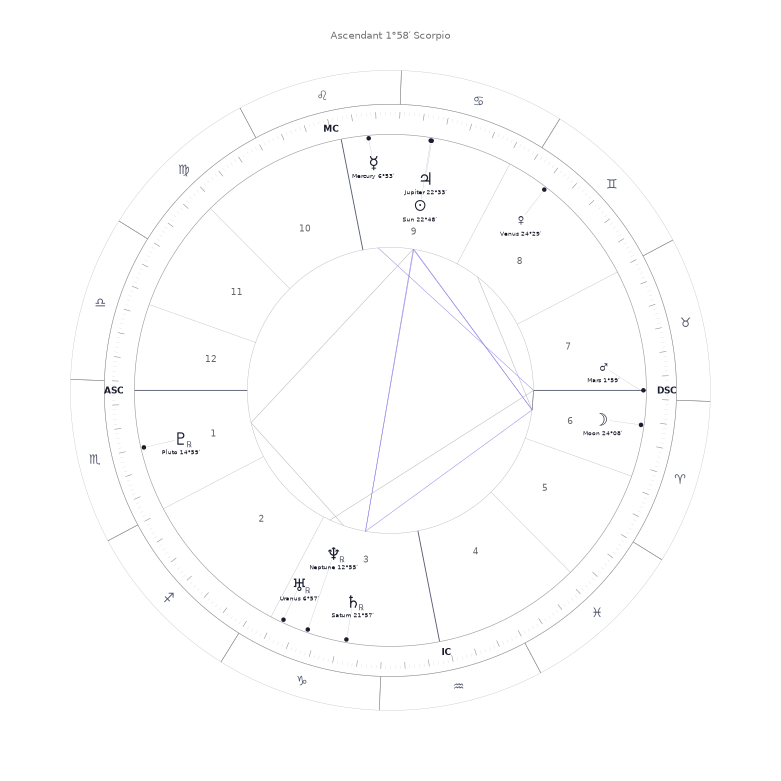
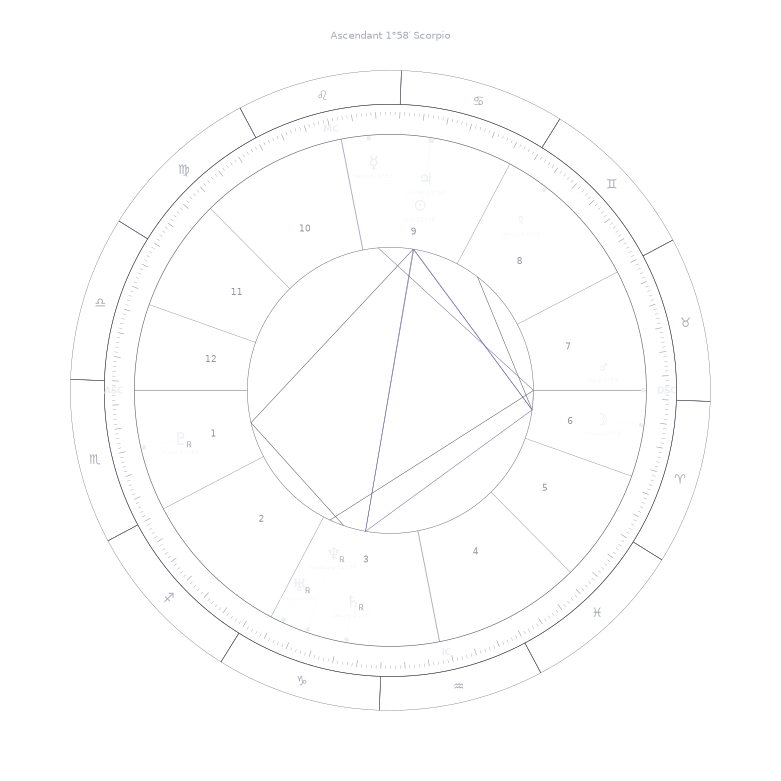
Open the example in the calculator. The outer ring contains the twelve signs, the inner numbers identify the houses and the central lines show aspects. Keep the symbol reference open if the glyphs are unfamiliar.
- Sun
- Cancer 22°48′21″
- Moon
- Aries 24°8′6″
- Ascendant
- Scorpio 1°58′5″
- House system
- Placidus
Degrees, minutes and seconds describe a position within a sign. The Sun's 22°48′21″ is not a clock time. It is an angle measured from the beginning of Cancer. These values let you check whether two planets in the same sign are actually close to each other.
Start with the Sun, Moon and rising sign
This example has the Sun in Cancer, the Moon in Aries and Scorpio rising. These are three different indicators in one chart, not interchangeable answers to the same question. Write each on its own line first. The Sun, Moon and rising guide explains how astrologers use them.
ASC marks the Ascendant on the wheel. It is not a planet. It is the intersection of the eastern horizon and the zodiac at the birth moment. MC marks the Midheaven, which relates to the local meridian. Our example has MC at Leo 13°2′56″. Avoid confusing the MC with the Sun, or the rising sign with the Sun sign.
Next, find the rising sign's ruler. In traditional rulership, Mars rules Scorpio. Here Mars is at Taurus 1°59′2″ in the seventh house. You have now followed the Ascendant to a specific planet in the chart. Linda Reid's lesson on rulership introduces this connection. A reading that uses modern rulers may also consider Pluto for Scorpio.
Planet, sign and house are different pieces of information
Read a complete table row: Sun, Cancer, 22°48′21″, house 9. Sun names the body, Cancer its zodiac sign, the degree gives its precise position and house 9 places it within the chosen house division.
In her lesson on houses, Linda Reid distinguishes signs from houses. The ninth house is traditionally associated with subjects such as distant travel, belief and learning. These topics provide an interpretive context. They do not establish someone's profession or prove that an event has happened.
Mercury shows why the house system matters. For this same birth, Mercury stays at Leo 6°53′25″ in both calculations. It falls in the ninth house with Placidus and the tenth with Whole Sign houses. Mercury has not moved. The method used to establish the house boundaries has changed.
Before applying an article to your own chart, check which house system it uses. A “Mercury in the tenth house” interpretation would not describe Mercury's house in this Placidus example. You can compare systems in the house calculator and explore their subjects in the twelve houses guide.
Reading aspects and orbs
An aspect is an angular relationship between two points on the zodiac. Its orb measures the distance from the exact aspect angle. Nicholas Campion's introduction describes conjunction at 0°, square at 90°, trine at 120° and opposition at 180°. The accepted orb can vary with the method.
- Sun and Jupiter
- Conjunction
- Conjunction orb
- 0.24°
- Sun and Saturn
- Opposition
- Opposition orb
- 0.85°
Compare the Sun's and Jupiter's degrees in the planet table. Both are in Cancer, about a quarter of a degree apart. The Sun and Saturn are in opposite signs, about 0.85° away from an exact 180° opposition. These are the numerical relationships behind the lines on the wheel.
A small orb tells you that an aspect is geometrically close to exact. It does not, by itself, mean a good or bad outcome. Begin with these two connections and add the planets' houses before examining the remaining aspects. The aspect reference gives their symbols and basic geometry.
If your birth time is unknown
Do not enter a guessed time as if it were known. When the time is left blank, the tool continues with a noon assumption. This does not recover the actual birth time. The Ascendant, MC and houses calculated from that assumption should not be treated as reliable personal placements.
Planetary degrees also depend on time. The Moon moves noticeably during a day and may even change sign if it is near a boundary. The unknown birth time guide explains what you can still use. A rising-sign table cannot remove the uncertainty of a missing birth time.
Why two charts may differ
If two sites give different results, compare their settings first. Do they use the same date, local time, location and daylight-saving conversion? Are both tropical, or is one using a sidereal zodiac? Do the house systems match? A sidereal chart uses a different zodiac reference.
Then locate the difference. If a planet's sign agrees but its house differs, the house system is a useful place to start. If the Ascendant differs noticeably, check the time and location again. If only a line colour or a symbol's drawn position differs, compare the numerical tables before concluding that the calculations disagree.
Keep the input details and settings with your reading notes. Comparing one planet across two systems, as we did with Mercury, can be more informative than comparing two entire wheels by eye.
How this wheel was made
The example's positions and aspects came from AstroMansion's ordinary natal calculation. The wheel was rendered from the same result. Standard planetary calculations use a local NASA JPL ephemeris on the server. JPL's ephemeris documentation describes this family of astronomical data.
The local clock time is resolved to the birth moment. Planetary positions supply the zodiac degrees, while the location and house system determine house boundaries. The calculation then assigns planets to houses and finds the selected aspects. The wheel is a visual presentation of those results.
Checking the calculation and continuing your reading
The accuracy page publishes the bodies, dates, method and raw results of the comparison. Measured accuracy for standard planets is not a blanket claim for every small body in the catalogue or for astrological interpretations.
For your own chart, record the Sun, Moon and Ascendant first. Read one planet's sign and house together. Then choose one of its aspects and check the orb. Those three short notes give you a more manageable start than interpreting every symbol at once. If you need additional bodies, check their coverage in the catalogue.